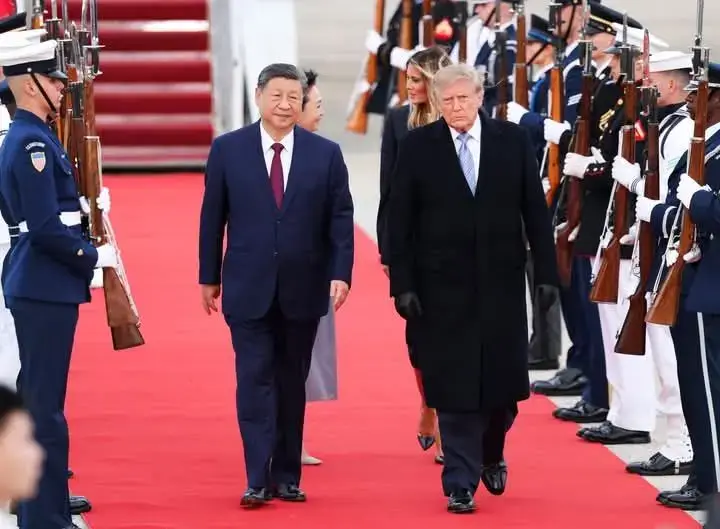
Chinese President Xi Jinping is paying a state visit to the United States from September 23 to 25, 2026, at the invitation of U.S. President Donald Trump. This marks Xi's first state visit to the United States in more than a decade.
His previous one took place in 2015 under President Barack Obama – and his first trip to Washington in eleven years. It is the third meeting between the two leaders in roughly a year, following their encounter in Busan, South Korea, in October 2025 and Trump's visit to Beijing in May 2026.
A rare airport welcome
Xi and First Lady Peng Liyuan arrived at Joint Base Andrews near Washington, D.C., on the afternoon of September 23 after a long flight. In a rare break from protocol, Trump and First Lady Melania Trump personally greeted them on the tarmac. The reception featured a red carpet, an honor guard, a military band, canon fire, and a B-1 bomber flyover – the first time a sitting U.S. president had personally welcomed a foreign leader at the base in eleven years.
In a written statement after his arrival, Xi emphasised that China and the United States should be partners rather than rivals. He noted that the two great nations and peoples have deeply intertwined interests, and that the great rejuvenation of the Chinese nation and the effort to make America great again can complement each other and benefit the world. He expressed anticipation for in-depth exchanges with Trump on bilateral ties and major global issues.
Key issues on the agenda
The visit centers on managing the complex U.S.-China relationship amid economic competition, technological rivalry, and geopolitical tensions. Key topics under discussion include trade and tariffs, with attention focused on extending and possibly expanding the Busan trade truce reached in late 2025. That arrangement had suspended certain tariff escalations and eased Chinese restrictions on rare-earth exports. U.S. Treasury Secretary Scott Bessent announced that the two sides had agreed to extend the truce from its previous November 10,2026, endpoint to January 10,2027.
Talks also cover potential reciprocal tariff reductions on roughly thirty billion dollars in non-sensitive goods, Chinese purchases of U.S. agricultural products building on earlier commitments, energy including liquefied natural gas, and aircraft. Technology and artificial intelligence from another major focus, encompassing export controls on advanced computing chips, AI safety guardrails, and broader competition in the field.
Reliable Chinese exports of rare earths and other critical minerals important to manufacturing and defense are also on the agenda, as are geopolitical questions surrounding Taiwan, the conflict involving Iran including the Strait of Hormuz, and the pursuit of strategic stability. Military-to-military contacts and fentanyl-related concerns have likewise featured in pre-visit discussions.
Both sides have framed the relationship around the concept of a constructive relationship of strategic stability, seeking to manage differences while pursuing cooperation where possible. Expectations for major breakthroughs remain modest; the visit is widely viewed as centered on optics, symbolism, and the stabilisation of ties rather than the resolution of deep structural disagreements.
The three-day schedule
The schedule for the visit is carefully choreographed. On September 23, Xi arrived and received the airport welcome. On September 24, a formal state arrival ceremony takes place at the White House, including a troop review in the Rose Garden, followed by expanded bilateral meetings in the Oval Office and Cabinet Room and a state dinner in the East Room. The dinner guest list is expected to include major U.S. technology and business leaders from companies such as Apple, Nvidia, OpenAI, and Tesla.
On September 25, the program includes a private tea with the Trumps, a guided tour of the National Archives – home to founding documents such as the Constitution and the Declaration of Independence – and departure.